Your Mind After Midnight by Rushati Chowdhury
A biodegradable material designed to respond to light.
- Year
- 2021
- Labs
- Spazio Chirale
- Techniques
- Laser CO₂, Inkjet
- Materials
- gelatines, pigments, PMMA, paper, calligraphy nibs
A process developed inside Chirale together with Rushati Chowdhury, artist and designer born in Calcutta in 1995, who arrived in Rome in 2019 as a student of the Master in High Fashion at Accademia Costume & Moda.
For years Chirale has been welcoming students of the Master into its labs, supporting the development of their thesis projects: not as mere production support, but as a real possibility of shared research. In this context Rushati developed with us some decorative elements of the collection presented on 27 October 2019 at BASE Milano, within Fashion Graduate Italia.
In the following years, the relationship evolved naturally into an artist residency. Spazio Chirale thus opened a more extended form of work: time, access to the labs, daily exchange, error, material archive. A slow structure, close to international residency models, in which experimentation does not accompany the work but coincides with it.
The six months preceding the opening were entirely dedicated to the development of a new pigmented biopolymer, designed specifically for the installation. The research focused on a precise question: to build a biodegradable material capable of holding natural pigments in mass, maintaining a diffuse semi-transparency at thin points, and reacting to direct light by producing chromatic projections legible in space.
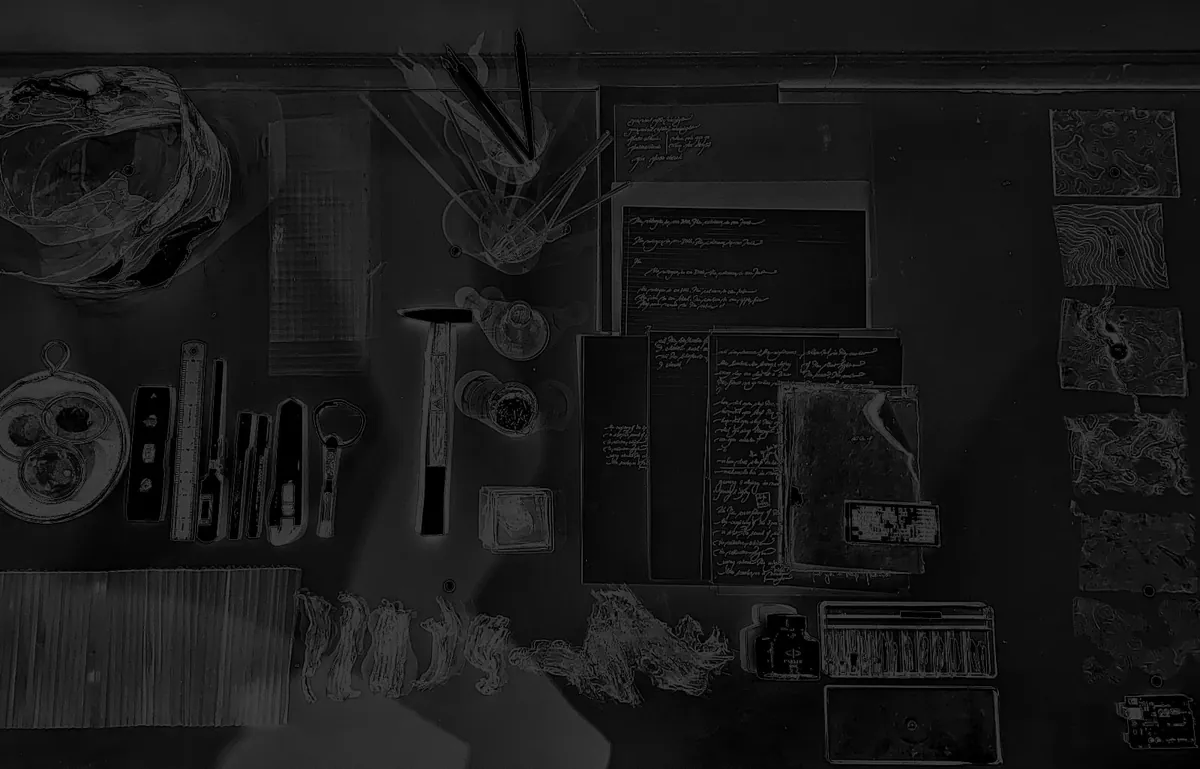
All the lab work was held in balance on these three requirements: pigment absorption, light transmission, optical behaviour. Formulations followed one another for months. Trials, variations of pigment concentration and dispersion, drying times, flexion tests, castings. Each sample was assessed not only for its composition, but for its physical behaviour: rigidity, flexion, drying time, quality of light transmission.
Many failed and were kept in the physical archive of the process: necessary traces of the research. The definitive formulation emerged only in the last weeks before the opening.
From 15 February 2021 the residency moved into the windows of Spazio Chirale, at Via Ignazio Persico 32 in Rome. For an entire week the process became public. From the street one could observe the preparation of the material, the castings, the slow drying, the manual modelling of each element, the progressive setting up of the space. It is the principle of the process gallery: not a finished work, but a material that takes shape under the eyes of those passing by, in slow times and in full light.
On Monday 22 February 2021, at 5:00 pm, Your Mind After Midnight opened to the public.
The work is composed of hundreds of elements, light and semi-transparent, arranged sinuously on the floor and rising along the walls. Each element carries within it the marks of pigment, distributed in the compound during casting. Rushati calls each element a stuck. In English the term recalls sleep paralysis; in German Stück indicates the piece, the object, the fragment of a work. In the middle of the second pandemic year, this double linguistic root becomes the emotional core of the work: immobility and multiplication, suspension and presence.
At the entrance every visitor receives a small portable lamp. The work is not contemplated frontally: it is activated. By directing the beam of light onto the stucks, the public continuously modifies the configuration of the space. The pigments contained in the biopolymer project onto the walls as chromatic shadows, the forms overlap, deform, multiply. The optical research developed in the preceding months thus leaves the lab and becomes shared experience.
Your Mind After Midnight therefore has no definitive image. It exists as a variable system, dependent on the presence of the public and on the orientation of light. An installation that does not ask to be observed, but to be crossed.
What remains today from the residency are the stucks kept in Chirale's archives and with the artist, the formulation samples preserved as material archive of the process, and the photographic documentation.